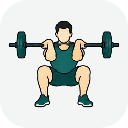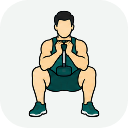
The kettlebell front squat is a squat with the bells held in the rack position: handles at your collarbones, bells resting on the outside of your forearms, elbows tucked in. Unlike a goblet squat, the load sits tight against your body and your upper back and abs have to keep it there — and with a bell on each side it can go heavier than anything you could hold at your chest with both hands.
How to do it
- Get the bells into the rack: handles deep in your palms, bells resting on the outside of your forearms, elbows against your ribs.
- Brace, then sit down between your knees with your chest up.
- Stand up through the whole foot without letting the bells pull you forward.
Common mistakes
- Letting the elbows drift out, so the bells slide off your forearms and drag your chest forward.
- Bending the wrists back under the bells instead of keeping them straight.
What it trains
- Quads
- extend the knees out of a deep, upright squat — the prime mover
- Glutes
- extend the hips as you stand
- Abs
- brace against a load sitting in front of your ribs, and against it pulling you sideways if you use a single bell
- Upper back
- keeps the chest up so the rack does not sag forward
Variations and alternatives
Common questions
One kettlebell or two?
Two if you have a matching pair: the load is even and it goes heavier. A single bell in one arm is a legitimate version too, and makes your abs work to stop you leaning toward it — switch arms from set to set. Pick one way and stay with it, because a single bell and a pair are different exercises as far as your numbers go.
What is the difference between a kettlebell front squat and a goblet squat?
Where the weight sits. In a goblet squat you hold one bell by the handle out in front of your chest; in the front squat the bells rest in the rack, stacked on your forearms and tight to your body. The rack takes a few sessions to get comfortable, but after that your arms stop being the limit and your legs can be.
Why does the kettlebell hurt my forearm in the rack?
Mostly because the handle sits too far toward your fingers, which leaves the bell hanging off the wrist instead of resting on the forearm. Grip deep in the palm with a straight wrist and let the bell settle in the crook between forearm and biceps. Some pressure is normal for the first weeks; bruising usually means the bell is landing hard as you bring it up.
How do I progress when kettlebells jump 4 kg at a time?
Build reps at one bell before you move up, and set this exercise's weight step in StackUp to match the jump between your bells. StackUp judges your heaviest set against your rep range, so with the step set right, the weight it suggests for next time is a bell you can actually pick up.
In StackUp. Logged as weight and reps per set, and your heaviest working set decides whether the weight goes up next time. Get the app.
Legs