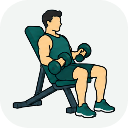
Lying back on an incline bench lets your arms hang behind your torso, which puts the long head of the biceps on stretch before the rep even starts — that head crosses the shoulder, so where your upper arm sits actually changes the exercise. It also makes the bottom of the curl genuinely hard, which is exactly where a standing curl is easiest.
How to do it
- Bench at 45–60° with the arms hanging behind the torso — that is the stretch you came for.
- Let the arm straighten fully at the bottom.
Common mistakes
- Sitting more upright to lift more, which removes the stretch entirely.
What it trains
- Biceps
- work from a stretched start, with the long head loaded harder than in any standing curl
- Brachialis
- flexes the elbow alongside, unaffected by the shoulder angle
- Forearms
- hold the dumbbells steady while the arms hang free behind the body
Variations and alternatives
Common questions
What angle should the bench be at?
Around 45 to 60°. Flatter gives a bigger stretch but starts to pull on the front of the shoulder, and much more upright turns it back into a standing curl against a backrest. If the stretch feels sharp rather than strong, sit the bench up a notch.
Why do I have to use so much less weight?
Because you have removed the two things that make a standing curl easy — the swing, and the shortened starting position. Expect a third to a half less than your standing dumbbell curl, and treat it as its own exercise with its own history rather than a bad day.
Should my arms stay straight down or drift forward?
Straight down, hanging behind the torso line, and they should still be there at the top. Letting the elbows swing forward as you curl gives the shoulder a way to help and undoes the only reason to lie on the bench.
In StackUp. Logged as weight and reps per set, and your heaviest working set decides whether the weight goes up next time. Get the app.
Arms