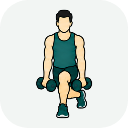
The curtsy lunge is a reverse lunge where the back leg crosses behind the front one instead of stepping straight back. Crossing over pulls the front hip into adduction, which puts more work on the outer glute than a normal lunge does — that is the entire reason the variation exists.
How to do it
- Step back and across behind the standing leg.
- The crossover biases the glute medius on the front leg.
Common mistakes
- Crossing so far that the front knee twists inward.
What it trains
- Glutes
- extend and stabilise the front hip, with the outer glute working harder than in a straight lunge because of the crossover
- Quads
- extend the front knee out of the bottom
- Adductors
- control the crossed leg and resist the hip rotating open
- Abs
- stop the torso twisting as the back leg crosses
Variations and alternatives
Common questions
Is the curtsy lunge bad for your knees?
It asks more of the knee than a straight lunge because the joint is loaded slightly rotated, so it is worth building up to rather than starting with dumbbells. Keep the front shin close to vertical and the front foot pointing forward, and step the back leg only as far across as you can go without the front knee caving in.
How far should I step behind?
Far enough that the back knee ends up roughly behind and outside the front heel, not out past the other side of your body. A deep cross looks impressive and mostly just makes you unstable.
Should I hold dumbbells or a single weight?
Two dumbbells at your sides are the easiest to balance and the easiest to bail out of. A single goblet-held weight at the chest is harder on the trunk and keeps you more upright, which some people find makes the balance easier rather than worse — try both and keep the one you can load.
In StackUp. Logged as weight and reps per set, and your heaviest working set decides whether the weight goes up next time. Get the app.
Glutes